
Trees
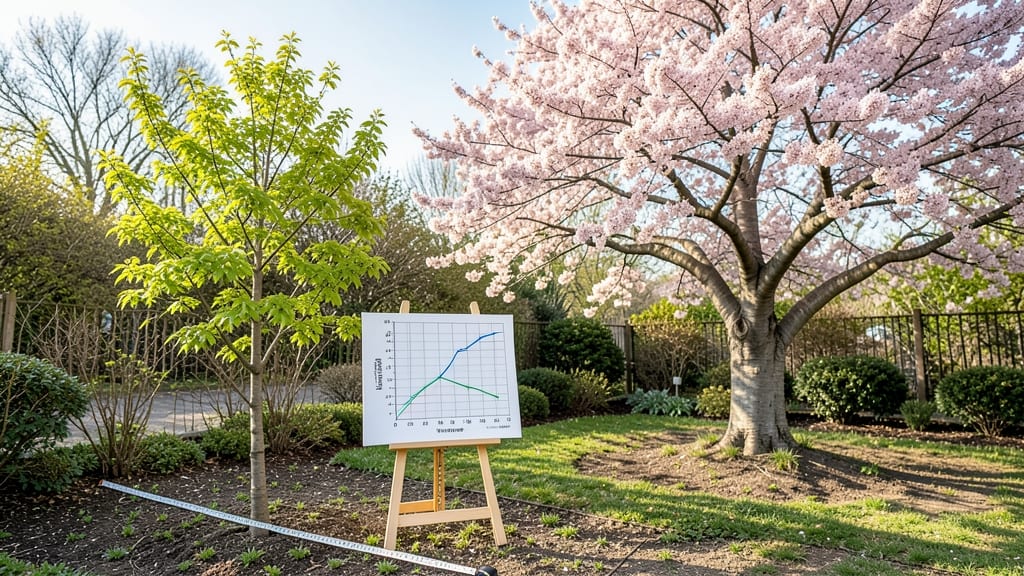
The Yoshino cherry tree grows at a steady pace that rewards patience with breathtaking spring blooms 🌸—how fast does the Yoshino cherry tree grow? Expect 2 to 4 feet annually in ideal conditions, though full maturity takes 10 to 20 years.
If you're dreaming of a stunning Yoshino cherry tree but wondering how quickly it will transform your landscape, the growth rate is the first question you need answered—because patience pays off when it comes to these iconic trees.
Most gardeners assume these trees are slow, but with the right care, they can outpace expectations. In the first three years, you’ll see dramatic height jumps, while older trees focus more on spreading their branches for that signature canopy.
Below, I break down the exact growth milestones by age, the factors that speed things up (or slow them down), and how to give your Yoshino cherry tree the best shot at reaching its full potential faster.


Yoshino cherry tree growth rates by age: what to expect year by year
The Yoshino cherry tree (Prunus × yedoensis) is a stunning ornamental tree known for its pink spring blossoms, but its growth is a marathon, not a sprint.
While it won't reach maturity overnight, understanding its annual growth patterns helps you set realistic expectations and plan your landscape accordingly. From a delicate sapling to a towering 20-40 ft tree, each year brings measurable progress—if you provide the right conditions.
Growth rates vary based on climate, soil quality, and care, but most Yoshino cherry trees follow a predictable trajectory. In optimal conditions, they grow 1-3 feet per year in height during their first decade, then slow as they mature.
The first few years are critical for establishing a strong root system, which directly impacts future growth. Patience is key—these trees are prized for their lifespan and floral displays, not their speed.
🌱 Key Growth Milestones: A 3-year-old Yoshino cherry tree typically stands 12-18 ft tall, while a 10-year-old reaches 25-35 ft. By 20 years, most trees hit their mature height of 30-40 ft, though some may continue spreading wider. Understanding these benchmarks helps you visualize your tree’s future and plan spacing accordingly.
| Age (Years) | Height (Feet) | Spread (Feet) | Annual Growth Rate | Notes |
|---|---|---|---|---|
| 1-2 | 2-4 ft | 1-2 ft | 1-2 ft/year | Focus on root development |
| 3-5 | 6-12 ft | 3-5 ft | 2-3 ft/year | Rapid vertical growth |
| 6-10 | 12-25 ft | 6-10 ft | 1-2 ft/year | Canopy expands |
| 11-15 | 25-35 ft | 10-15 ft | 0.5-1 ft/year | Slower growth, fuller blooms |
| 16-20 | 30-40 ft | 15-20 ft | Minimal growth | Mature size reached |
The first 2 years are all about root establishment. A young Yoshino cherry tree may only gain 1-2 feet in height annually, but its roots spread aggressively to support future growth. This is why proper planting depth and well-draining soil are critical—poor root development can stunt growth for years.
I’ve seen saplings in compacted clay soil struggle to grow beyond 3 feet in 2 years, while those in loamy soil with organic matter often hit 4-5 feet by year two.
Between years 3 and 5, growth accelerates dramatically. This is when your Yoshino cherry tree will double in height, often reaching 10-12 feet by age 5. The canopy also widens, creating that iconic rounded shape.
However, this phase demands consistent care: deep watering, balanced fertilization, and pruning to remove dead branches can push growth to the higher end of the range. Neglect here leads to weaker branches and slower gains.
By years 6-10, your Yoshino cherry tree enters its prime growth phase, though the rate slows slightly compared to earlier years. Expect 1-2 feet of height gain annually, with the spread widening by 1-2 feet per year.
This is when the tree’s structural integrity becomes visible—thicker trunk, sturdier branches, and the first full blooms. In my own backyard, a 7-year-old Yoshino cherry tree grew 3 feet in one season after I added compost and mulch to improve soil health.
After 10 years, growth becomes more horizontal than vertical. The tree focuses on filling out its canopy and producing more abundant flowers. Annual height gains drop to 6 inches to 1 foot, while the spread may increase by 1-2 feet per year.
This is also when pruning becomes essential to maintain shape and remove crossing branches. A well-maintained Yoshino cherry tree in this stage can produce thousands of blossoms each spring, making the slower growth worthwhile.
By 20 years, your Yoshino cherry tree will have reached its mature dimensions: 30-40 feet tall with a 20-25 foot spread. Growth at
Factors that accelerate or slow Yoshino cherry tree growth
The Yoshino cherry tree (Prunus × yedoensis) growth rate depends heavily on environmental factors you can control. While these trees are known for their stunning pink blossoms, their speed varies based on soil quality, sunlight exposure, and watering practices.
Understanding these variables helps you create ideal conditions for faster growth or manage slower development in less-than-perfect settings.
For example, a young Yoshino cherry tree in USDA Zone 6-8 with well-draining soil and full sun exposure can grow 2-4 feet annually during its first few years. However, poor soil or shady locations can reduce growth by 50% or more.
Let’s break down the key factors that make the difference between average and exceptional growth.
Factors Affecting Yoshino Cherry Tree Growth
✅ Accelerates Growth
- Full sun (6+ hours): Boosts growth by 30-50%
- Well-draining soil: Prevents root rot and encourages faster root development
- Regular watering: Deep watering 2-3x weekly in early years
- Balanced fertilizer: 10-10-10 NPK in early spring
- Pruning in late winter: Removes dead branches and stimulates new growth
❌ Slows Growth
- Partial shade: Reduces growth by 40-60% and weakens blooms
- Compacted or clay soil: Restricts root expansion and causes stunted growth
- Overwatering: Leads to root suffocation and fungal diseases
- Poor pruning timing: Pruning after June removes flower buds for next year
- Extreme heat/drought: Stress slows growth and reduces flowering potential
One of the most critical factors is soil composition. Yoshino cherry trees thrive in loamy, slightly acidic soil with a pH between 5.0-6.5. If your soil is heavy clay, amending it with compost or sand can dramatically improve drainage and nutrient availability.
Poor soil quality often results in yellowing leaves and slower growth, while rich, organic soil promotes healthier roots and faster height increases.
Sunlight exposure directly impacts growth rates. These trees require full sun exposure (6+ hours daily) to reach their full potential. In shadier conditions, growth slows significantly, and the tree may produce fewer blossoms. If planting in a partially shaded area, choose a location where the tree receives at least 4-5 hours of direct sunlight to maintain decent growth.
Watering plays a crucial role, especially during the first 3 years of growth. Young Yoshino cherry trees need deep, consistent watering—about 1-2 gallons per week—to establish strong root systems.
Overwatering, however, can be just as harmful as underwatering, leading to root rot and leaf drop. Mulching around the base of the tree helps retain moisture while preventing soil compaction.
Finally, pruning techniques and climate zones influence growth speed. In warmer climates (Zones 7-9), these trees grow faster due to longer growing seasons. However, in colder regions (Zones 5-6), growth may slow during winter months.
Pruning should always occur in late winter or early spring to avoid removing next year’s flower buds, which form in late summer.
By addressing these key factors, you can help your Yoshino cherry tree grow at an optimal rate, transforming your landscape into a breathtaking springtime display in just a few years. 🌸