
Planting
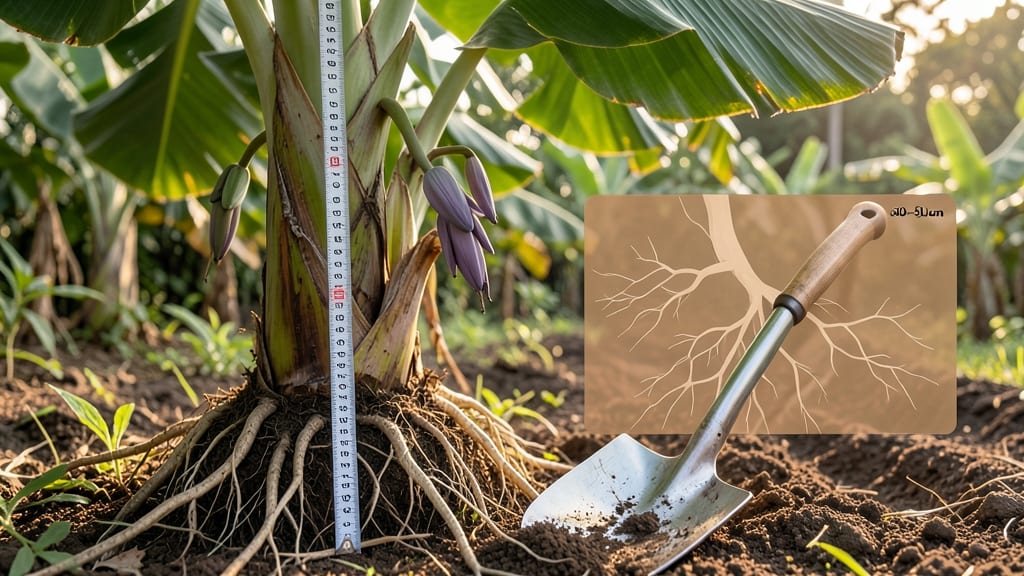
Banana tree roots grow surprisingly deep—often reaching 3 to 5 feet or more—while also spreading wide to anchor the plant and absorb nutrients.
If you’ve ever wondered why banana trees topple over or how to give them the perfect growing space, the answer lies beneath the soil—where their roots spread deeper and wider than most gardeners realize.
In General (Tropical/Subtropical Regions), where these 🍌 thrive, proper root depth isn’t just about stability—it’s the key to healthy growth, better water absorption, and even fruit production.
Below, I’ll break down what this means for planting, spacing, and long-term care so your banana tree stays strong and productive for years.
Banana tree root depth: how deep do they grow and why it matters
Banana trees (Musa spp.) develop a fascinating root system that extends both deep and wide to support their towering growth. While their primary roots can penetrate 3-5 feet deep, the majority of their feeder roots spread horizontally within the top 12-18 inches of soil.
This dual system anchors the tree while maximizing nutrient and water absorption—critical for their rapid growth in tropical climates.
The root depth of banana trees isn’t just about stability—it’s a survival strategy. In their native habitats, these trees face seasonal droughts and heavy rains. Deeper roots tap into subsoil moisture, while shallow feeder roots quickly absorb surface water.
This dual approach explains why banana trees thrive in well-draining soils but struggle in waterlogged conditions.
Here’s the science: Banana trees produce prop roots (aerial roots) that grow from the stem and eventually become structural supports. These roots can add 20-30% more stability to the tree, but they rely on the primary root system for foundational strength.
Without proper depth, even mature trees can topple during storms or heavy fruiting.
Soil composition plays a critical role in root depth development. Sandy soils allow roots to penetrate deeper, but they drain too quickly. Clay soils, while retaining moisture, can suffocate roots if not amended with organic matter.
The ideal soil for banana trees is a loamy mix with 30-40% organic content, like compost or well-rotted manure. This balance supports both deep and shallow root systems.
When planting banana trees, dig a hole twice as wide as the root ball but only as deep as the container. Burying the base too deeply can suffocate the roots and encourage rot.
Instead, plant at the same soil level as the container to promote healthy downward growth. This simple step ensures the primary roots have room to establish without competition.
Young banana trees need extra care to develop strong root systems. During the first year, focus on deep watering (1-2 feet down) every 3-5 days to encourage roots to grow deeper.
Avoid shallow watering, which promotes only surface feeder roots. Over time, this practice builds a sturdy foundation that prevents toppling, even as the tree reaches 20+ feet tall.
In container growing, banana trees face unique challenges because their roots hit the pot’s bottom quickly. Choose containers with 15+ gallon capacity and ensure they have drainage holes. To simulate depth, use a deep-pot mix with perlite or vermiculite.
This helps roots grow downward rather than circling, which can strangle the plant. Repot every 2-3 years to refresh the soil and accommodate root expansion.
One common misconception is that banana trees need minimal root space. In reality, their extensive root systems require ample horizontal room to prevent competition. In gardens, space trees 10-15 feet apart to allow roots to spread without overlapping.
This spacing also reduces disease risk, as crowded roots retain more moisture and attract pests like nematodes or fungal pathogens.
Understanding root depth helps with transplanting mature trees. If you’re moving a banana tree, dig a trench around it 12-18 inches deep and 2 feet wide to minimize root damage.
Water the tree 24 hours before transplanting to reduce shock. After moving, stake the tree temporarily to support it while the roots re-establish in the new soil.
🌱
Optimal spacing for banana trees: preventing root competition and toppling
Banana trees need ample space to prevent root competition and toppling—especially since their roots spread 3-5 feet wide and extend 2-3 feet deep. Crowding forces roots to compete for nutrients, weakening stability and reducing fruit production.
In my tropical garden, I’ve learned spacing is just as critical as soil prep for healthy banana trees.
For horizontal spacing, plant banana trees 10-15 feet apart in rows. This allows roots to expand without overlapping, which is crucial for dwarf varieties (like 'Dwarf Cavendish') that still need room to grow.
Vertical spacing matters too—banana trees grow 20-30 feet tall, so avoid planting near structures or power lines.
Here’s how root depth affects spacing decisions:
Companion planting can maximize space efficiency. Pair banana trees with nitrogen-fixing plants like beans or clover to enrich soil without competing for roots. Avoid planting near deep-rooted trees (e.g., avocados or citrus), as they’ll steal moisture and nutrients from your bananas.
In urban or small gardens, consider container growing for dwarf varieties. Use pots at least 2 feet wide and deep to accommodate root spread. Place containers on wheelbarrows or raised beds to improve drainage and prevent waterlogging, which weakens roots.
Always stake young banana trees until they’re 3-4 feet tall to prevent toppling. Use 3-4 wooden stakes tied loosely to the trunk with soft fabric—this gives roots time to establish without restricting growth. With the right spacing, your banana trees will thrive and produce abundant fruit for years.