
Propagation
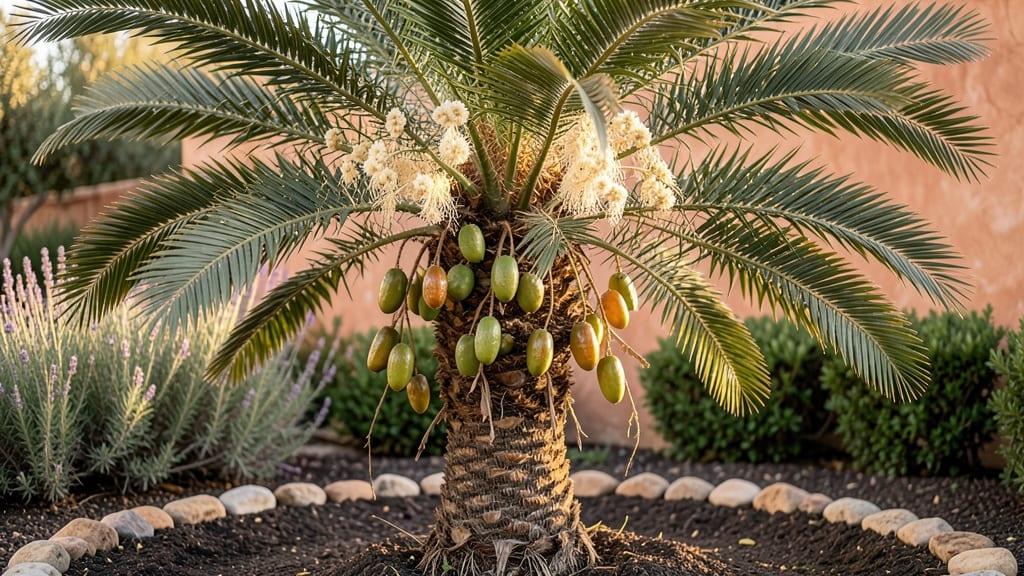
Dates come from the date palm tree (Phoenix dactylifera), a hardy desert palm thriving in arid climates with its tall, feather-like fronds and distinctive spiky trunk. This fruit-bearing tree has been cultivated for over 5,000 years in regions like the Middle East and North Africa.
This iconic palm isn't just a tropical curiosity—it's the backbone of date production worldwide. 🌵 The Phoenix dactylifera thrives in extreme heat and minimal water, making it perfectly adapted to desert environments where most plants would wither.
What's fascinating is how its growth cycle aligns with fruit production: male and female flowers grow on separate trees, requiring either natural pollination by wind or careful hand-pollination for commercial crops.
The tree's ability to survive drought and poor soil conditions has made it a cultural and economic cornerstone for centuries.
Fun fact: There are over 1,000 date varieties, each with unique flavors and textures. 🌟 The most common types you'll find in stores—like Medjool and Deglet Noor—come from different palm cultivars, each with its own growing requirements and harvesting windows.
This diversity is what makes date palms so valuable both commercially and historically.
💡 In This Article
- Identifying Date Palm Trees: Key Characteristics and Growth Habits
- Growing Date Palms at Home: Climate, Soil, and Care Essentials
Identifying date palm trees: key characteristics and growth habits
The date palm (Phoenix dactylifera) stands out with its fan-shaped fronds that arch gracefully, reaching 15-20 feet long on mature trees. Each frond has 150-200 leaflets arranged in precise rows, creating a lush, feathery appearance that's instantly recognizable.
The trunk itself is thick and fibrous, often covered in old leaf bases that form a natural armor against desert winds and temperatures exceeding 120°F. 🌵
One of the most striking features is the tree's inflorescence—the massive flower clusters that emerge from the trunk before fruiting. Male flowers produce pollen, while female flowers develop into dates. The fruit starts as small, green, and hard before ripening into the sweet, caramel-colored dates we know.
Interestingly, the tree's roots can extend 10-15 feet deep to access groundwater, while its shallow root network spreads wide to capture rare rainfall—a perfect adaptation for arid environments.
The tree's growth cycle is tightly linked to its environment. In its native Middle Eastern habitats, date palms flower in spring (March-April) and fruit matures by fall (September-October). This timing allows the fruit to develop during the cooler months when water is more available.
The palm's ability to photosynthesize efficiently even at high temperatures is due to its specialized stomata (pores) that minimize water loss while still allowing gas exchange—a survival trick that's been perfected over millennia. 💧
You can distinguish date palms from other palms by several key traits: their single, unbranched trunk (unlike coconut palms), the horizontal rings left by old leaf bases, and the distinctive "crownshaft" where the trunk widens before the fronds emerge.
The fruit's development is also unique—dates grow directly from the flower clusters without needing branches, a feature that makes the tree's architecture both efficient and elegant. This combination of features makes date palms one of the most recognizable and economically important tree species in the world.
What's particularly fascinating is how the tree's leaf structure contributes to its drought resistance. The fronds have a waxy coating that reduces water loss, while their vertical orientation helps reflect sunlight.
This adaptation allows the palm to thrive in areas where other plants would struggle, making it a true desert specialist. The tree's ability to store water in its thick trunk further enhances its survival capabilities in harsh conditions. 🌡️
For those interested in botany, the date palm's monoecious nature (male and female flowers on separate trees) is crucial for fruit production. This means you'll need both male and female trees in your grove for natural pollination to occur.
The tree's rapid growth rate—up to 2 feet per year in ideal conditions—makes it one of the fastest-growing palm species, reaching maturity in just 4-8 years under optimal care.