
Plants
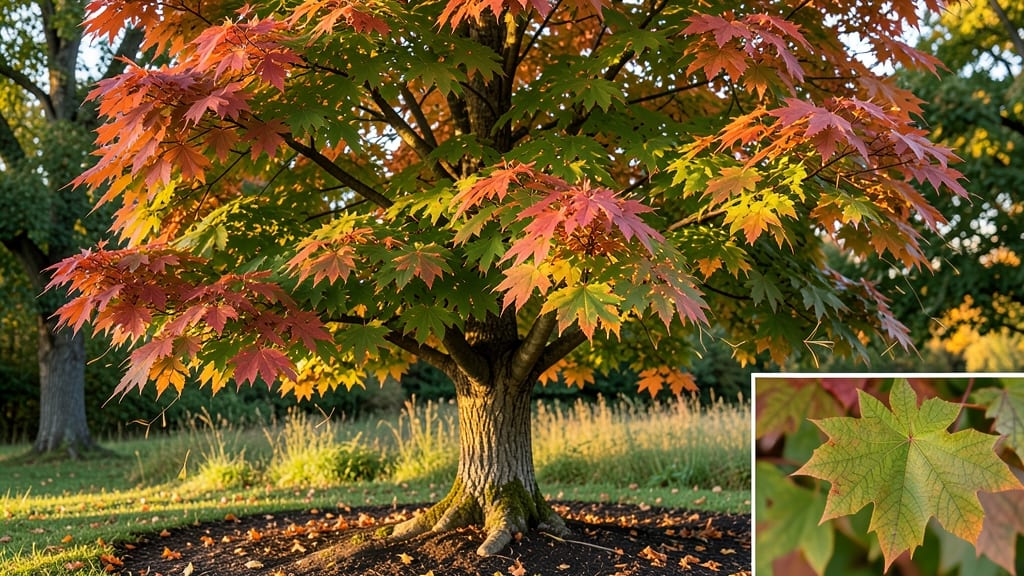
A maple tree looks like a medium-to-large deciduous tree with distinctive fan-shaped leaves featuring 3-9 sharp lobes, smooth gray bark that develops shallow grooves as it ages, and branches that grow directly across from each other. Its leaves turn brilliant red, orange, or yellow in autumn, depending on the species.
Maple trees are instantly recognizable by their unique leaf structure—those classic fan-shaped leaves with pointed lobes that inspired everything from Canada's flag to Halloween decorations. 🍁 The bark starts smooth and silvery-gray but develops deeper ridges as the tree matures, creating a textured pattern that's easier to spot in winter when leaves are gone.
What sets them apart from oaks or beeches is that branching pattern: maples grow their branches in perfect opposite pairs, creating a symmetrical look that's visually striking year-round.
One of my favorite identification tricks is checking the leaf scars when the tree is dormant—they form a distinctive U-shape that's unique to maples. This detail, combined with their fall color display, makes them some of the most photogenic trees in the landscape.
If you're trying to tell a sugar maple from a red maple, look at the leaf edges: sugar maples have more rounded lobes while red maples have sharper, more pointed ones.
💡 In This Article
- Identifying Maple Tree Leaves and Bark Features
- How to Spot Maple Trees in Different Seasons
Identifying maple tree leaves and bark features
The most iconic feature of maple trees is their palmate leaves, which spread out like fingers from a single point. Sugar maples typically have 5 lobes with rounded edges, while red maples show 3-5 sharper lobes that create a more jagged silhouette.
Silver maples stand out with their deeply divided lobes that almost look like separate leaflets, while Norway maples have 3-5 broad lobes with smooth edges. 🌿 The leaf size varies too: sugar maples average 4-6 inches wide, while silver maples can reach 8 inches or more.
The bark transforms dramatically as maples age. Young trees display smooth, silvery-gray bark that reflects sunlight, but as they mature (typically after 30-50 years), it develops shallow furrows that create a diamond-shaped pattern.
Sugar maples' bark becomes deeply grooved with age, while red maples maintain a smoother texture with more subtle ridges.
This bark texture is particularly useful for winter identification when leaves are absent. 🌳 The opposite branching pattern—where branches grow directly across from each other—is another key trait that distinguishes maples from oaks or beeches.
Leaf arrangement and vein structure offer additional clues. Maple leaves always grow in opposite pairs along the stem, creating a symmetrical look when viewed from above. The veins radiate outward from the central stem in a palm-like pattern, with secondary veins connecting to form small compartments.
This structure helps channel nutrients efficiently during photosynthesis. 🍃 For precise identification, examine the leaf underside: sugar maples have a slightly hairy texture, while red maples are smoother.
Color variations provide further differentiation. Sugar maples produce bright orange-red foliage in autumn, while red maples turn scarlet red with orange undertones. Silver maples display golden-yellow hues, and Norway maples often show yellow-green tones before turning brown.
These autumn colors result from chemical changes in the leaves as chlorophyll breaks down and other pigments like carotenoids and anthocyanins become visible. 🍂 The timing of color change also varies: sugar maples typically peak 2-3 weeks earlier than red maples in most regions.
One advanced identification trick involves examining the leaf scar left when a leaf falls. Maple leaf scars form a distinctive U-shaped pattern with multiple bundle scars where nutrients traveled from the stem to the leaf. This differs from oak leaf scars which are more half-moon shaped.
The presence of 3 main bundle scars (one large and two smaller) is another hallmark of maple leaf scars. 🔍 This detail becomes particularly useful during winter when other identifying features are absent.