
Trees
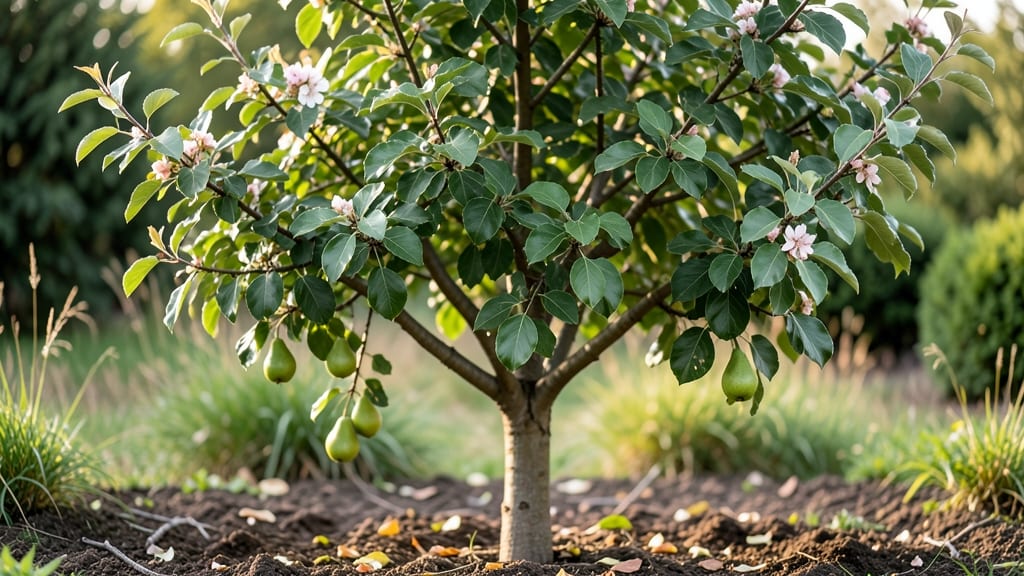
Pear tree leaves look like elongated ovals with serrated edges, a glossy deep green top, and lighter undersides. They typically measure 2–4 inches long, grow alternately along branches, and often have a slightly asymmetrical base.
Pear tree leaves are easy to recognize once you know what to look for.
Their oval shape with a subtle point at the tip sets them apart from many other fruit tree leaves, while the sawtooth-like serrations along the edges create a distinctive jagged outline. 🌿 The glossy finish on the top surface reflects light beautifully, and the lighter green undersides help distinguish them from similar-looking foliage.
These leaves grow in an alternating pattern along the branches, which is a key identifier when comparing them to other trees.
What makes pear leaves particularly unique is their pinnate venation—the veins branch out from a central midrib like fingers on a hand. This pattern, combined with their 2–4 inch length, helps differentiate them from apple leaves (which are more rounded) or peach leaves (which are more elliptical).
The asymmetrical base is another subtle clue that experienced gardeners often notice first.
💡 In This Article
- Identifying Pear Tree Leaves: Key Botanical Features
- How to Tell Pear Tree Leaves Apart from Similar Trees
Identifying pear tree leaves: key botanical features
Pear tree leaves showcase a fascinating blend of symmetry and asymmetry that botanists call "unequally cordate" at the base—meaning one side is slightly larger than the other. This subtle irregularity helps distinguish them from perfectly symmetrical leaves like those of apple trees.
The serrated edges are particularly distinctive, with 10-15 sharp teeth per inch that create a sawtooth pattern when viewed closely. These serrations aren't uniform; they're slightly more pronounced toward the leaf's tip, creating a gentle wave effect along the margin.
The pinnate venation system is another key identifier, where secondary veins branch out at 45-60 degree angles from the central midrib, creating a ladder-like pattern. This differs from apple leaves, which have more rounded veins that create a more web-like network.
The leaf's 2-4 inch length combined with its 1-2 inch width gives it an elongated oval shape that's more rectangular than the broader ovals of peach tree leaves. 🌿 The glossy upper surface contains stomata (pores) that are more concentrated on the undersides, which helps regulate gas exchange while maintaining that characteristic shine.
Seasonal changes reveal even more details. In spring, new leaves emerge with a reddish-purple tint that fades to deep green as they mature. By autumn, they often develop yellow or bronze hues before falling, unlike apple leaves which turn more uniformly red.
The alternate arrangement along branches (one leaf per node) creates a staggered pattern that contrasts with compound leaves like those of hawthorn trees, where multiple leaflets grow from a single stem.
One often-overlooked feature is the leaf stalk (petiole), which is typically 1/4 to 1/2 inch long and slightly swollen at the base where it attaches to the leaf. This swelling helps distinguish pear leaves from cherry leaves, which have much shorter petioles.
The combination of these features—serrated edges, pinnate veins, asymmetrical base, and glossy texture—creates a visual fingerprint that makes pear leaves instantly recognizable to trained eyes.
For a hands-on identification method, try the "leaf rub test": Rub a mature pear leaf gently between your fingers. The slightly rough texture from the serrations combined with the silky smooth surface creates a distinctive tactile sensation that differs from the smoother apple leaves or the slightly hairy peach leaves.
This sensory approach works particularly well when visual identification is challenging, such as when leaves are obscured by branches.
The scientific name for pear trees, Pyrus, reflects these botanical characteristics. The genus name derives from the Greek word for "pear," while the species names often reference leaf shape or arrangement.
For example, Pyrus communis (common pear) emphasizes the widespread nature of trees with these distinctive leaves, which have been cultivated for thousands of years across temperate climates.