
Neem Oil
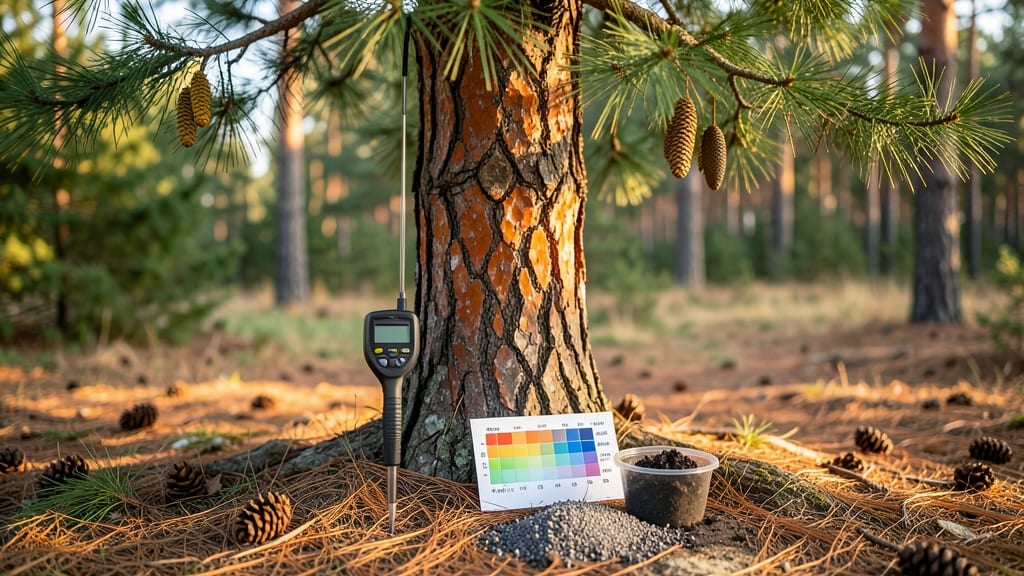
The ideal pine tree soil pH is a game-changer for how fast and healthy your 🌲 grows.
Picture this: your pine tree sits in the ground, needles bright and full, while others in your neighborhood struggle with yellowing or stunted growth. The difference? Soil pH. Most pines crave acidic soil—think 4.5 to 6.0—but one wrong number, and your tree fights for nutrients instead of thriving.
Testing your soil is easier than you think, and adjusting it—whether with lime to raise pH or sulfur to lower it—can unlock faster growth and better resistance to pests. Even small tweaks make a big difference over decades.
In this guide, I’ll walk you through the exact pH range for your pine species, how to test your soil, and step-by-step fixes to keep your tree healthy and strong for years to come.
Optimal pine tree soil pH range: what your tree needs to thrive
Pine trees are finicky about their soil, and pH balance is the foundation of their health. Most pines thrive in acidic to slightly acidic soil, but the exact range varies by species.
For example, eastern white pine and lodgepole pine prefer pH 4.5–5.5, while ponderosa pine can tolerate pH 5.0–6.5. Even small pH deviations can slow growth, yellow needles, or weaken roots—so testing is critical before planting.
Why does pH matter so much? Pine trees absorb essential nutrients like nitrogen, phosphorus, and iron most efficiently in acidic conditions. A pH above 6.0 locks out these nutrients, causing deficiencies that mimic drought stress.
Meanwhile, pH below 4.0 can release toxic aluminum and manganese, damaging roots. Regional native pines often adapt to local soil pH, but transplanted trees may struggle without adjustments.
Testing your soil’s pH is easier than ever with home test kits (digital meters or liquid test strips) or a lab analysis. For pines, dig a 6-inch-deep hole near the root zone, collect soil, and test it. Most kits cost under $20 and deliver results in minutes.
If your soil tests outside the ideal range, amendments like sulfur (to lower pH) or lime (to raise pH) can restore balance—but timing and application matter to avoid shocking roots.
Regional variations play a role too. In the Pacific Northwest, where Douglas fir and western white pine dominate, naturally acidic soils (pH 4.5–5.5) support lush growth. Conversely, southeastern pines like longleaf adapt to pH 5.0–6.0 due to sandy, well-draining soils.
If you’re planting a non-native pine, mimic its native soil conditions as closely as possible for the best results.
Even if your soil pH is slightly off, don’t panic—many pines are resilient. For example, a ponderosa pine might survive in pH 6.5–7.0, but its growth rate will slow by 30–50% compared to ideal conditions.
The key is to monitor and adjust gradually. If you’re planting a young pine seedling, mix sphagnum peat moss into the planting hole to create an acidic microclimate around roots.
Nutrient absorption is directly tied to pH. In acidic soils (pH 4.5–5.5), pines access iron, manganese, and zinc efficiently, leading to darker green needles and faster growth. But if pH drifts above 6.0, these nutrients become unavailable, causing chlorosis (yellowing between veins).
Over time, this weakens the tree’s immune system, making it susceptible to pests like pine bark beetles or diseases like needle blight.
For container-grown pines, pH management is even more critical. Use a well-draining acidic mix (e.g., 50% peat moss, 30% pine bark, 20% perlite) and retest pH every 6–12 months. Containers dry out faster, accelerating pH shifts.
How to adjust pine tree soil pH for faster growth: step-by-step guide
Adjusting your pine tree soil pH is one of the most effective ways to boost growth and vitality. Most pine species thrive in acidic soil with a pH range of 4.5 to 6.0.
If your soil is too alkaline or acidic, your pine will struggle to absorb essential nutrients like iron and manganese, leading to stunted growth and poor health.
Before making changes, test your soil using a pH testing kit or send a sample to a local extension office. This step is critical—many gardeners overcorrect because they assume their soil is too alkaline when it’s actually just slightly off.
For example, a white spruce might tolerate pH 6.0, while a loblolly pine prefers closer to 5.0.
⚠️ callout-warning ⚠️
⚠️ Common Mistake: Over-Amending Soil
Adding too much lime (to raise pH) or sulfur (to lower pH) can shock your pine tree’s roots. Always adjust pH gradually—aim for a change of no more than 0.5 pH points per year. For example, if your soil is at 7.0 and needs to reach 5.5, plan for 3 years of adjustments, not a single massive treatment.
🌱 Pro Tip: Mix amendments into the top 6-12 inches of soil where roots are active. Avoid piling materials directly against the trunk.
To raise soil pH (if it’s too acidic), use elemental sulfur or peat moss. Sprinkle 1-2 pounds of sulfur per 100 square feet and water thoroughly. For organic options, try pine needles or composted oak leaves, which naturally acidify soil over time.
Re-test after 3-6 months—pH changes take time, especially in clay soils.
If your soil is too alkaline (pH above 6.5), lower it with elemental sulfur, aluminum sulfate, or organic matter like composted pine bark. Work 2-3 pounds of sulfur per 100 square feet into the topsoil in early spring.
Avoid quick fixes like vinegar, which can harm beneficial microbes and burn roots.
After adjusting, retest soil pH every 6 months for the first year, then annually. Pine trees show slow but steady growth when soil conditions are stable.
For example, a Scotch pine in properly adjusted soil can grow 1-2 feet per year, while an imbalanced pH might limit it to just 6 inches. Patience and consistency are key!
Finally, mulch with pine bark or wood chips to maintain acidity naturally. This also suppresses weeds and retains moisture—critical for young pines. Just avoid over-mulching, as a thick layer can suffocate roots and slow growth.
With the right pH, your pine will reward you with lush foliage and rapid height gains. 🌲