
Pruning
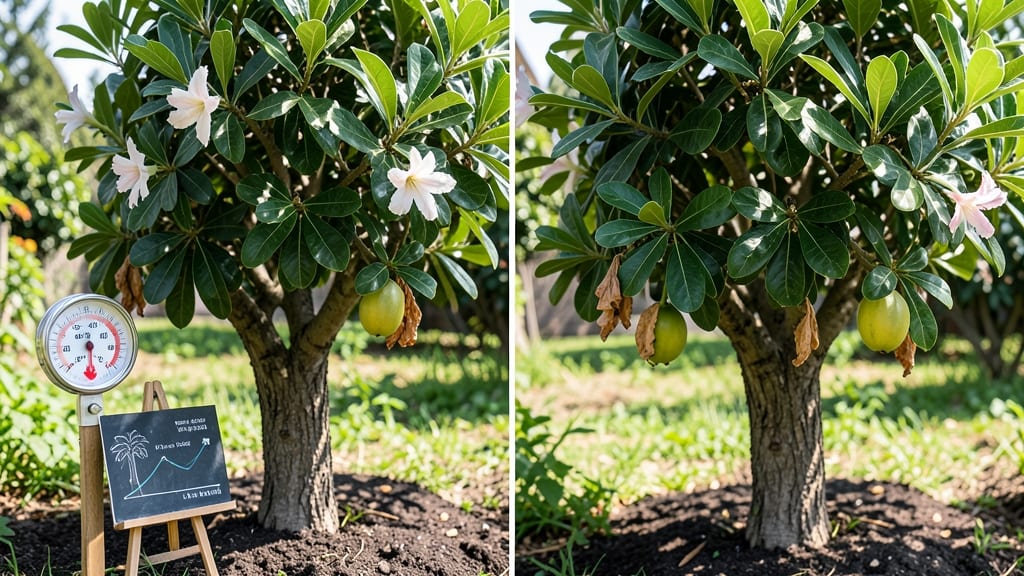
Guava trees have a temperature tolerance down to 28°F (-2°C), but their survival depends heavily on exposure duration and maturity. Prolonged cold below 32°F (0°C) can cause irreversible damage, especially to young trees or frost-sensitive varieties like 'Red Malaysian'.
The temperature tolerance of a guava tree helps you prepare for winter. 🌡️ The key factor is how quickly temperatures drop—sudden freezes are harder on trees than gradual cooling. Young trees under 3 years old need extra protection because their root systems aren't deep enough to buffer cold.
For mature trees, the real risk comes from wind chill and radiation frost, which can push temperatures lower than official forecasts suggest. I've seen 'White Marvel' guavas survive 25°F (-4°C) in sheltered microclimates, but only with thick mulch and frost cloth.
Your tree's variety also matters—some tropical types like 'Kumagai' can't handle any frost, while subtropical varieties like 'Alligator Pear' might survive brief dips to 28°F (-2°C). Always check your local USDA zone to match your guava's needs.
For example, if you're in Zone 8, you'll need winter protection, while Zone 10 growers can focus on summer heat management.
💡 In This Article
- How Cold Does a Guava Tree Survive? Science Behind Frost Sensitivity
- Guava Tree Winter Care by USDA Hardiness Zone
How cold does a guava tree survive? Science behind frost sensitivity
Guava trees' cold tolerance comes down to cellular biology. When temperatures drop below 32°F (0°C), water inside leaf cells begins crystallizing, which ruptures cell membranes—a process called freeze-thaw damage. This disrupts nutrient transport and photosynthesis, causing brown patches or leaf drop.
The roots act as a buffer, but shallow root systems in young trees (3 years old) can't absorb enough heat from deeper soil layers to protect the canopy. 🌱
Tropical guava varieties like 'Kumagai' have almost no cold resistance—their optimal range is 65-90°F (18-32°C), and any frost triggers irreversible damage. Subtropical types like 'Alligator Pear' fare better, surviving brief dips to 28°F (-2°C) thanks to thicker leaf cuticles that slow water loss.
The difference lies in their evolutionary origins: tropical guavas evolved in frost-free regions, while subtropical varieties developed in areas with mild winters.
Wind chill exacerbates the problem by accelerating moisture loss from leaves, which makes them more vulnerable to frostbite. I've observed that trees in exposed locations suffer 2-3°F (1-2°C) colder conditions than sheltered ones due to wind exposure.
This is why microclimates matter—trees near buildings or dense foliage often survive colder nights because these structures trap heat. The root zone also plays a role: deeper roots in mature trees can access warmer soil 6-12 inches below ground.
Another critical factor is the duration of cold exposure. A single night at 28°F (-2°C) might cause minor leaf damage, but 3 consecutive nights below 32°F (0°C) can kill a young tree's growing tips.
This is why gardeners in marginal zones (Zone 8-9) need to monitor forecasts and act preemptively. The science shows that guava trees can recover from light frost damage if the roots remain unfrozen, but repeated cold stress leads to cumulative harm over seasons.
For variety-specific examples, 'Red Malaysian' guavas—popular for their vibrant fruit—struggle below 35°F (2°C), while 'White Marvel' can handle brief dips to 25°F (-4°C) with proper protection.
The key difference lies in their native climates: 'White Marvel' originated in subtropical regions with occasional cold snaps, while 'Red Malaysian' comes from tropical lowlands with consistent warmth. 🌡️
What most growers overlook is how soil temperature affects root survival. Even if air temperatures drop to 28°F (-2°C), the soil may stay above freezing if it's well-mulched. A 4-inch layer of straw or wood chips can maintain soil temps 5-10°F warmer than ambient air, giving roots critical protection.
This thermal insulation is why mulching is the first line of defense against cold damage.